
 English
  Japanese
  Chinese
 Choosing Between the JetXpert and the JetXpert Inline
Last Updated on July 30, 2026 by ImageXpert Team
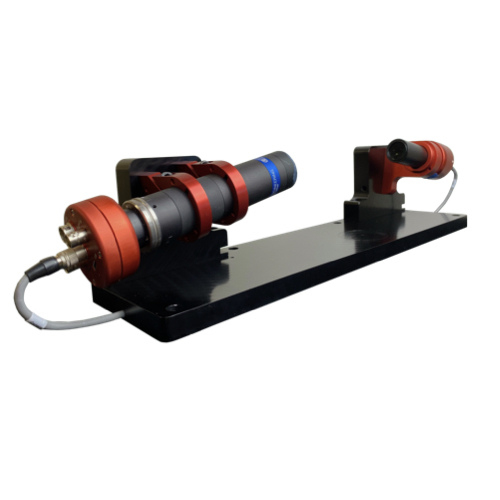
The fundamental difference in the design and intended use of the JetXpert and the JetXpert Inline is their optical configuration. The standard JetXpert uses flat optics, with the camera and light source facing each other across the drop stream, while the JetXpert Inline places an angle between the camera and light source and sits below the printhead. In most cases, this makes the JetXpert best suited for as a standalone R&D system and the JetXpert Inline for integration into production systems, but we’ll dive into the details below to help you select the best system for your needs.

The Optical Differences
The standard JetXpert uses flat optics: the camera and the light source sit in line with each other, and the printhead is positioned in the gap between them. This arrangement is flexible. You can analyze drops at any distance from the printhead, and it works with essentially any printhead, dispenser, or similar technology. That is why flat optics are the original and most popular configuration. However, this orientation comes with a physical trade-off. The printhead has to fit in the roughly 200mm space between the camera and the light source, which becomes a problem when you are dealing with a wide printhead array that simply will not fit.
The JetXpert Inline uses angled optics to address that exact limitation. Instead of placing the head between the camera and light source, it puts an angle between the two and sits below the printhead. Because nothing has to fit in a fixed gap, there is no printhead size limitation, and the system can image all the nozzles across any number of heads in an array. That makes the JetXpert Inline the better choice when you are integrating drop analysis into a large production machine carrying many printheads.
What Angled Optics Reveal
Fitting large arrays is not the only advantage of the angled view. Looking up at the printhead, the Inline reveals more about nozzle activity, wetting, and meniscus behavior than a side-on flat view can. This is especially useful on printheads with recessed nozzles, which are not normally visible from the side. For that kind of nozzle-level investigation, the angled optics can show detail the flat setup cannot.
The Trade-offs of the Angled Approach
The angled configuration comes with two real limitations. The first is working distance: for most printheads, drops go out of focus beyond about 1.5 to 2 mm from the nozzle, so the Inline is limited to low-throw analysis. If you need to study drops farther from the printhead, flat optics are the way to do it. It is worth noting that the standard JetXpert Inline also uses a fixed 2 mm field of view, where the standard JetXpert offers an adjustable 1 to 6 mm.
The second limitation is the surface it depends on. The angled method needs a reflective surface such as a nozzle plate to reflect light to the camera, so results vary slightly from one head model to the next, and it does not work well with most dispensers.
Beyond the Optics
The standalone JetXpert is designed with printhead mounting, ink collection, and the hardware to run as a complete unit. It also has a selection of extra cameras, motorized stages, and other accessories to enable and automate specific tests like wetting, latency, or sustainability. The JetXpert Inline is built to integrate into a customer printer and presumes mounting, movement, and fluid collection is managed by the printer.
On the software side, both run the same software on Windows with a GUI and optional TCP/IP control. The standalone JetXpert unlocks the complete add-on suite for tests like sustainability, open time, and waveforms; the JetXpert Inline focuses on drop visualization with volume and velocity.
How to Choose
We recommend basing the decision on the optics and what they let you see:
- Choose the standard JetXpert with flat optics if you need to analyze drops at a range of distances, work across many printhead types or with dispensers, or simply have a printhead that fits the imaging gap. It is the default for good reason.
- Choose the JetXpert Inline with angled optics if you need to image a wide, multi-head array that will not fit flat optics, you want deeper nozzle, wetting, and meniscus detail (especially on recessed nozzles), and your heads have mirror-like nozzle plates. Just plan around the low-throw working range.
If you are weighing the two for a specific printer or printhead, the fastest way to settle it is to talk through your setup with someone who knows both optical configurations. ImageXpert’s engineering team can review your printheads, analysis needs, and integration constraints and recommend the right system. Reach out through the contact page to set up a live demo.