
 Chinese
  English
  Japanese
 Choosing Between the JetXpert and JetXpert Jr
Last Updated on 7 月 30, 2026 by ImageXpert Team
The JetXpert and JetXpert Jr both give you a clear view of drops in flight, but they are built for different jobs: the JetXpert is a complete, standalone platform for inkjet R&D, while the JetXpert Jr is a compact dropwatcher designed to be integrated into your own test station or printer. This guide walks through how the two differ in intended use, hardware, and software so you can match the right system to your work.

What Each System is Built For
The JetXpert is designed for research and development of inks, printheads, and printers. It ships as a complete, standalone unit with all the hardware needed to start measuring, and it scales up to include sample printing on the JetXpert PrintLab or JetXpert 打印台. A suite of add-ons extends and automates common tests for wetting, sustainability, open time, and waveforms, which makes it a natural fit for a lab that runs a wide range of experiments.
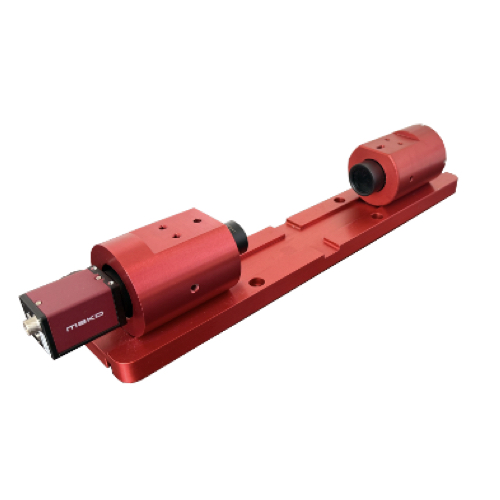
The JetXpert Jr takes a narrower, more embedded role. It is a compact dropwatcher meant for integration into your own test station or a printer, where it handles jetting visualization and analysis. If your goal is to add drop measurement to a system you are already building, the Jr is the piece designed to slot in.
Hardware: Standalone Platform vs Integrated Module
The hardware is where the two systems diverge most. The JetXpert includes adjustable magnification from 1 to 6mm field of view (a full range of 0.5mm to 20mm available as customization), so a single system covers a wide range of drop sizes and test types. It also includes printhead mounting and positioning hardware to study every nozzle, optional ink delivery and collection systems, and options for additional cameras, motorized stages, and other tools that streamline inkjet R&D.
The JetXpert Jr strips this down to the essentials for integration. Magnification is fixed at 1.5, 3, 6, or 12 mm field of view, chosen to match the size of your drops. Printhead mounting and positioning are handled by your system, as are ink delivery and collection. In practice, the Jr assumes you already have the mechanical and fluidic infrastructure and simply need the imaging.
Software and Analysis
Both systems run the same software on Windows, with a GUI and optional TCP/IP control, so the interface and integration hooks are consistent across the two. The difference is in the capabilities each one unlocks. On the JetXpert, you get the complete set of add-ons, including automated waveform optimization, open time testing, and sustainability tests. The JetXpert Jr focuses on the core analysis: drop visualization along with volume and velocity.
How to Choose
The decision usually comes down to how you plan to work.
- Choose the JetXpert if you want a complete, self-contained R&D system, need to study full nozzle arrays, want ink delivery and collection handled for you, or expect to use the automated test add-ons. It suits a lab running varied experiments across inks, printheads, and printers.
- Choose the JetXpert Jr if you are embedding drop analysis into an existing test station or printer, mainly need jetting visualization with volume and velocity data, and are prepared to provide printhead mounting and ink handling yourself. It suits the case where imaging is the only piece you are missing.
If you are weighing the two for a specific application, the fastest way to settle it is to talk through your needs with someone who knows both systems. ImageXpert’s engineering team can review your setup, test plans, and integration constraints and recommend the right configuration. Reach out through the contact page to set up a live demo.